<div style='background-color: none transparent;'></div>
Showing posts with label ConnectionMusic. Show all posts

The Sandpipers Sing Chotto Matte, Misty Roses

Saturday, March 19, 2011

THE SANDPIPERS:

Stephen Thomas Erlewine, when writing about The Sandpipers, wrote that they were a male vocal trio that recorded easy listening pop hits in the mid 60s and was "distinguished by its light, breezy harmonies, which floated over delicate, breezy string arrangements, as well as the occasional appearance of a wordless female backing vocalist who drifted in and out of the music."

Sandpipers did not manage to have a long, sustained career but had one Top Ten hit with Guantanamera in 1966 (numerous Asian versions: check 'Guantanamera' under Labels below). There were other songs like Beyond The Valley Of The Dolls, Misty Roses, Today, Chotto Matte Kudasai and covers. The group was originally known as the Four Seasons and the trio were part of the Californian Mitchell Boys Choir before they formed their own group. Famous trumpeter Herb Alpert (remember him with his Tijuana Brass), who ran his own A&M record label was impressed when he heard them and signed them to a record contract.

An added female vocalist, Pamela Ramcier, "was one of the most distinctive elements of the group's music" and with her mod outfit of mini-skirts and a-go-go boots "made her more noticeable than the actual Sandpipers."

In 1970, Come Saturday Morning became a hit when it was part of the soundtrack for the movie, The Sterile Cuckoo. The Sandpipers continued to record into the '70s but after five years without any chart success, they disbanded in the mid-'70s. (Please read the next posting below.)

Image: The Sandpipers - Jim Brady, Mike Piano, Richard Shoff.

More about Sandpipers: http://new.music.yahoo.com/sandpipers/biography/
Continue Reading | komentar

Chotto Matte Kudasai, Excuse Me While I Cry...


SONGS I LOVE:
.
An English song by The Sandpipers but with a Japanese title is Chotto Matte Kudasai. In Japanese (ちょっと待ってください) it means, 'please wait a second' or 'please wait a moment.' although 'Shosho omachi kudasai' is more polite.
.
The simplicity and sentiment of the lyrics, possibly conjuring an image of a beautiful girl or young man (depending on the singer), make it so popular that it has been recorded in other languages. Singapore, Malaya, other Asian 60s music artistes like Frankie Cheah and Frances Yip have recorded it.
.
Martin Denny has quite a sugary version vocalised by an Asian lady. In the new century a Filipino group called Joey de Leon and The Sex Bombs has another. It is a lounge favourite with both pianists and night clubbers, a karaoke 'must sing' and can be heard in any building that plays elevator music.
.
A hit with elementary keyboard enthusiasts, Chotto Matte music notes are found within the pages of numerous books teaching children songs. Like Que Sera Sera and Annie Laurie, the melody is loved by many young 'uns. Three cheers for evergreens.
.
Chotto matte kudasai
Please excuse me while I cry
Seems sayonara means goodbye
But no one ever told me why

Sakura was in the spring
When our hearts found songs to sing
But Sakura has gone away
And so has our love, so they say

Chotto matte kudasai
Please excuse me while I cry
Without your love I would die
Please don’t leave me kudasai...
.
Image: Google Images.
Original article: Andy Lim
Continue Reading | komentar

Singapore Street-Hawker Calls And Elvis' 'Crawfish'

Sunday, February 20, 2011


Singapore street hawkers or vendors in the 60s have been highlighted as being unique and special. Many stories have been written about them and one author, Chan Kwee Sung in his book, One More Story To Tell, highlights the street laksa (page: 44) sold in the Katong area in the East Coast and the hot porridge (page: 49) in downtown Chinatown. These memories are etched forever in the minds of those who have lived the period and seen the food-sellers .

I remember my own encounter with these street hawkers along Geylang Road in Singapore where they advertise their food using their own unique/special hawker calls to draw out customers from their homes.
.
The meat-bun man will shout his, "Char siew pau..." as he pushes his cart filled with hot, steaming buns in containers balanced over a charcoal fire. Then there's the chicken porridge man selling his, "Kaiiiii choke."
.
The won-ton noodle hawker's assistant who strikes a small bamboo piece with a stick, using a rhythmic beat to announce his delicious meal for 30 cents a bowl. "Tock, tick, tock, tick, tock, tick, tick, tick, tock..." I even recall the Indian rojak (spicy salad) who shouts his ware along the pavements of Geylang with, "Rojak, rojak..." Street sounds we call them. Or food sounds?

The food hawkers mentioned by our local writers are not uncommon in other parts of the world (images). There are street hawkers everywhere and Singapore is no different. In fact the opening scene of the Elvis Presley movie, King Creole (Paramount: 1958) depicts street hawkers selling their wares in downtown New Orleans in the 50s. (please watch video above). After the film title, Elvis duets with singer Kitty White to sing Crawfish.

Elvis describes the catch:
"I went to the bayou late last night
There wasn't no moon but the stars were bright
Put a big long hook on a big long pole
And I pulled Mr Crawfish outta his hole

The street call:
Crawfish, craw-aw-aw-feeesh!
See I got 'em see the size
Stripped and clean before your eyes
Sweet meat look good
Fresh and ready to cook...
Craaawfeeesh!

The sales pitch:
Now you take Mr Crawfish in your hand
He's gonna look good in your frying pan
If you fry him crisp and you boil him right
He'll be sweeter than sugar with every bite
Crawfish..... crawfish...
(Song credited to: Fred Wise/Ben Wiseman)

Whether it's food culture or otherwise, the world has been connected a long time ago. Like the funeral bands in New Orleans and our own Singapore funeral marching bands - the similarities are astounding.
.
Perhaps there is one difference between Singapore's street vendors and those from the West; they are more imaginative and sing their wares.
.
Can you remember other popular 60s songs with food as a theme?

Images: 1. Paramount Studios/Elvis Presley Estate. 2. National Heritage Board Singapore.
Original article: Andy Lim.
Book Quote: One More Story To Tell - Memories of Singapore - 1930s to 1980s (Chan Kwee Sung: Landmark Books, 2005).
.
(This posting is for Derek Tait who's just joined as a Follower. Thanks Derek. Welcome home!)
SINGAPORE HAWKERS' FOOD
Continue Reading | komentar

New Orleans Jazz Bands And Chinese Funeral Bands

Sunday, February 6, 2011


As a child I remember street music in Singapore which comes from Chinese funeral processions. These funeral bands play melodies from both Chinese and English pops. One particular pop song that I can still recall, Today, (You're) Not Coming Home (Jin Tian Bu Hui Jia 今天不回家), has been played so many times at Chinese funeral street marches that it's been accepted as the unofficial theme song for the occasion (Image 2: a band at Kim Yam Road taken in 1970 in Singapore).

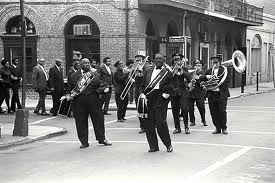
Books from the US that discuss the history of jazz music claim that jazz bands began from dance bands or social orchestras. These were African American bands that played on the streets in New Orleans, U.S.A. officiating at funeral processions. They play solemn music on the way to the burial yard and hot jazz on the way back (Image 1: a New Orleans jazz funeral).

It is common knowledge in the 60s that some Singapore band boys who play in the night-clubs freelance and work as funeral musicians in the day. Again the parallel; New Orleans dance orchestras do not confine themselves to playing in the ballrooms but played at funerals. Nothing to be ashamed of because it's honest living.

These funeral bands could comprise from eight members onwards and the instruments included trumpets, trombones, snare drums and cymbals. The Chinese funeral bands have the same number of people with similar instruments.

During a bigger and longer procession at a Chinese funeral (indicating the wealth of the deceased), more instruments could be used, like the larger bass drums and a tuba. When questioned why music is played during such a tear-jerking occasion, the band members explain that the noise drives evil spirits away. Comment?

Original article: Andy Lim
Image 2: National Heritage Board, Singapore.
Image 1: allaboutjazz.com
Continue Reading | komentar

Lam Chun See Remembers Teresa And Jimmy

Wednesday, January 26, 2011

THANK YOU CHUN SEE: Read his comments under Jimmy Linchong's posting. Ayo Mama or Ai Qing Nali Lai is by Teresa Teng. She learnt this song together with Rasa Sayang when she stayed in Indonesia. Rasa Sayang and Ayo Mama originated from the Maluku Islands (Spice Islands) of Indonesia.

Doesn't matter if you can't read Chinese. Enjoy song on the Right Bar >>>>>

印度尼西亚民歌

小河弯弯 流水不断来
河里的水草
跟着漂过来
流水长在 长流那天外
问一声河里水草哪里来

哎哟 妈妈
莫非也像我的恋爱
哎哟 妈妈
可是来的这样奇怪
哎哟 妈妈
怎么你不讲个明白
谁知道我的爱情哪里来

小河弯弯 春风吹过来
河边的花香
跟着飘过来
遍地花开 芬芳到心怀
问一声春天从哪里来

哎哟 妈妈
你可不能不理不睬
哎哟 妈妈
我的寂寞情意难挨
哎哟 妈妈
给我怎么样的安排
你可叫我怎样的安排
谁知道我的爱情哪里来

Ayo Mama: Indonesian lyrics (literal translation):

Ayam hitam telurnya putih (Black chicken too has white eggs)
Mencari makan di pinggir kali (Searching for food by the lakeside)
Sinyo hitam giginya putih (Dark-skinned bride has white teeth)
Kalau ketawa manis sekali. (When she smiles, she's so sweet)

Ayo mama, jangan mama marah beta (Oh mum, don't you scold me)
Dia cuma cuma pegang beta (He's just holding her playfully)
Ayo mama, jangan mama marah beta (Oh mum, don't you scold me)
Lah orang muda punya biasa. (It's natural with the young)
Anyone willing to help with the Mandarin translation? Doesn't matter anyway. It's the beat that matters. Cha-cha-cha!!!
Continue Reading | komentar
 
Copyright © 2011. stunners-aff . All Rights Reserved
Company Info | Contact Us | Privacy policy | Term of use | Widget | Advertise with Us | Site map
Template Modify by Creating Website. Inpire by Darkmatter Rockettheme Proudly powered by Blogger